THE SHORT ANSWER
Who fixes an AI-generated website
If you built on Lovable, Bolt, v0, or Replit and the site now has to carry real revenue, you don't need a teardown — you need a rescue: an agency keeps what already converts and rebuilds only what's leaking. The four fixes that matter are a distinct brand instead of the generated same-template look, conversion paths that don't dead-end, capture wiring into your CRM and calendar, and the markup that gets a site found and cited. Side Studios runs this as a Rescue Sprint from $8k CAD, pointed at an AI-built site instead of a blank page. Start by scoping what to keep versus rebuild before anyone writes code.
FIRST, CREDIT WHERE IT'S DUE
You made the right call.
If you built your first site with Lovable, Bolt, v0, or Replit, start by giving yourself credit: you validated cheap and shipped fast, which is exactly what an early-stage founder should do. Spending $25k on a brand system to test an idea nobody had paid for yet would have been the mistake. The generated site did its one job — it proved someone wanted the thing.
The question worth asking isn't whether you were wrong to use a builder. You weren't. It's whether the site that validated the idea is the same site that should now carry real revenue, real buyers, and a real brand. Usually it isn't — not because the tool is bad, but because the job changed. A tool built to get you online fast is not built to make you win once winning is on the line.
THE HONEST INVENTORY
What generated sites quietly get wrong.
Generated sites tend to fail in the same five places once traffic and stakes rise. None of these show up in a quick look — they surface when a real buyer, a search engine, or an assistive tool actually uses the site. Here's the inventory we run on every AI-built site that comes in for a rescue. The first check is brand consistency: an AI build rarely ships a real style guide, so type, spacing, and color quietly drift from page to page.
The same-template look
AI builders draw from the same training patterns, so generated sites share a family resemblance — the same hero shape, the same gradient, the same stock geometry. Buyers can't name it, but they feel it, and in a market where distinctiveness is the scarce good, looking generated is the fastest way to read as replaceable. A real design system is what breaks the resemblance.
Conversion paths that dead-end
Generated pages look like a site but rarely think like a funnel. The CTA competes with three others, the form asks too much, and there's no considered path from landing to booked. The layout renders; the journey doesn't. This is usually the single biggest leak — traffic arrives and leaves without a next step it was designed to take.
Integrations that were never wired
The value of a business site lives between the systems — the form that reaches your CRM, the booking that hits your calendar, the lead that triggers a follow-up. Generated sites hand you a form that emails you, if that. The capture wiring that turns a visit into a tracked, followed-up lead is precisely the part a builder leaves for later, and later never comes.
SEO and AI-search invisibility
Generated markup is often thin where it counts: weak headings, missing schema, no answer-first structure, inconsistent entity data. So the site ranks poorly on Google and, increasingly worse, goes uncited when a buyer asks ChatGPT or Claude who to shortlist. You can have a live site that is effectively invisible to the two systems that now route buyers to you.
Accessibility gaps
Generated output frequently misses the basics — color contrast, focus states, alt text, keyboard navigation, semantic structure. That excludes real customers, and for regulated buyers it's a liability, not a nicety. Retrofitting accessibility after the fact costs more than building it in, and it belongs on the inventory long before an audit forces the issue.
WHAT A RESCUE INVOLVES
Keep what works, rebuild what wins.
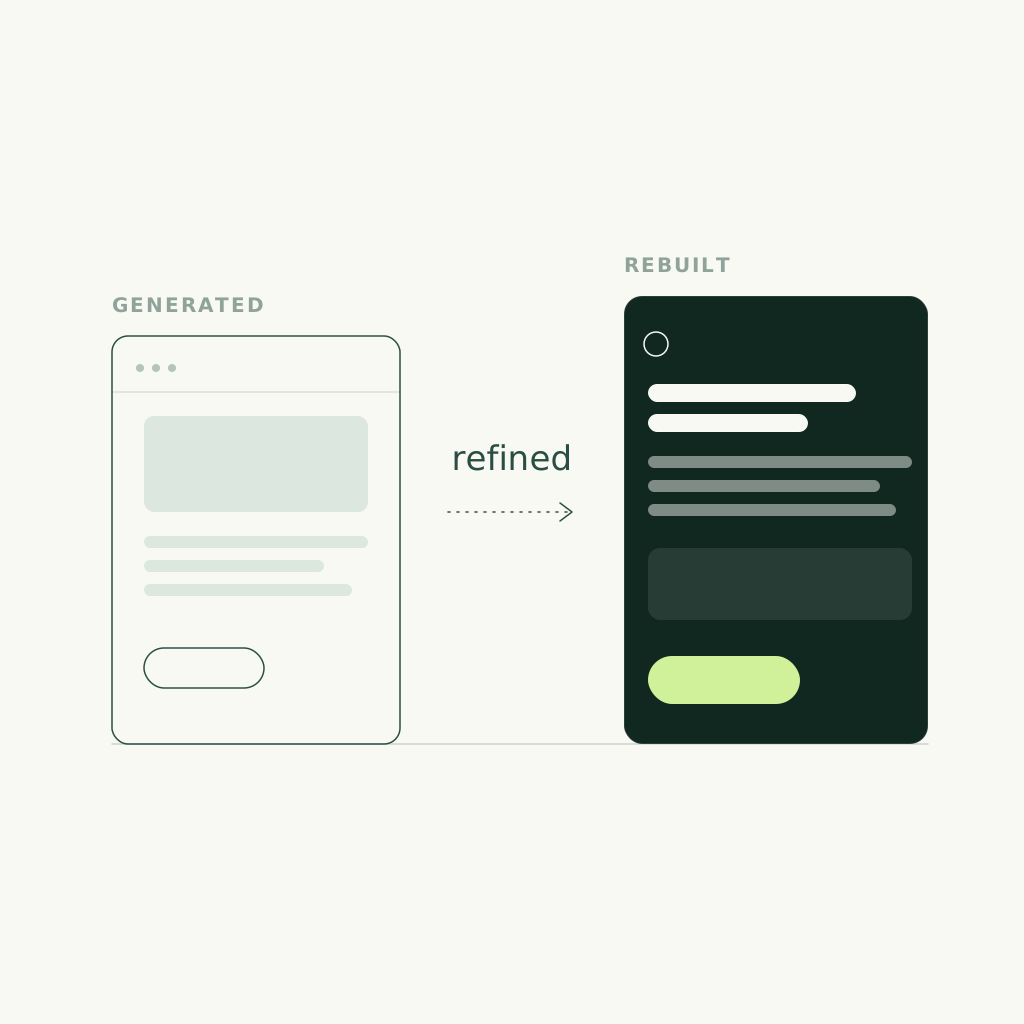
A rescue is not a teardown, and it shouldn't be sold as one. The point is to keep the parts of your generated site that already earn their place and rebuild only the parts that are costing you buyers. In practice that means auditing what converts and preserving it, then replacing the same-template brand, the dead-end paths, the missing integrations, and the thin markup with a system built to win. We package this as the Rescue Sprint, from $8k — the same tier mechanics as a focused Studio Sprint, aimed at an AI-built site rather than a blank page. It usually returns a site that keeps your validated content and momentum but reads, converts, and gets found like it was built for the stage you're actually at. If you're still deciding whether a rescue or a full rebuild is right, our honest breakdown at lovable vs hiring an agency walks through when each one makes sense. In our own work, a rebuild lifted a client's visibility in AI answers from 1 of 14 prompts to 8 of 14 that cited their site (cyrabeauty.ca, measured before vs after the June 2026 rebuild).
WHEN TO WAIT
When not to hire anyone yet.
The honest answer, and the one most agencies won't give you: sometimes the right move is to keep the generated site a while longer. If you're pre-revenue and still changing the offer every month, a paid rebuild is premature — you'd be paying to polish a hypothesis that's still moving — though it is worth running the DIY-versus-agency time math before you assume staying put is free. If the site isn't the constraint on growth, spend the money on whatever is. And if a single lever is leaking — a slow reply, a bloated form, one weak page — that's a fix you may be able to make yourself in an afternoon, not a project to outsource. Hire a studio when the leaks compound and the site is demonstrably holding revenue back: the brand undersells you, buyers don't convert, nothing routes into a system that follows up, and you're invisible in search. Our category-level breakdown at ai website builder vs web design agency lays out where a builder is genuinely enough and where it stops working. When you cross that line, a rescue pays for itself; before it, patience does. If you can't tell which side of the line you're on, run a Brand Score first — it reads brand, conversion, and capture wiring on your live generated site and hands you the three fixes that matter most, so you spend only when the site is genuinely the constraint.
SOURCES
WCAG 2.2 — the accessibility basics generated output misses (color contrast, focus states, alt text, keyboard navigation, semantic structure), as published on w3.org, fetched 2026-10-06.
Lovable — a ship-fast prototype tool for validating cheap, as published on lovable.dev, fetched 2026-10-06.
v0 — Vercel's AI UI generator, as published on v0.dev, fetched 2026-10-06.
FAQ
Common questions.
Was it a mistake to build my site with Lovable or an AI builder?
No. Validating cheap and shipping fast is exactly what an early-stage founder should do, and a generated site is a smart way to prove someone wants the thing before spending real money on brand and build. The mistake is only keeping that site once it has to carry real revenue, real buyers, and a real brand — because the job changed, not because the tool was wrong.
What do AI-generated websites get wrong most often?
Five things, in our experience: a same-template look that reads as generic, conversion paths that dead-end, integrations that were never wired, thin SEO and AI-search markup that leaves the site uncited, and accessibility gaps. None show up in a quick look — they surface when a real buyer, a search engine, or an assistive tool actually uses the site.
What does fixing an AI-built website actually cost?
We run it as the Rescue Sprint, from $8k — the same tier mechanics as a focused Studio Sprint, pointed at an AI-built site instead of a blank page. The final number depends on how much of your generated site is worth keeping versus rebuilding. As a rule, cleaning up a generated site costs a fraction of a full ground-up build, because the validated content and structure carry forward.
Should I fix the generated site or rebuild from scratch?
Keep what already converts and rebuild only what's leaking — that's a rescue, and it's the right call for most sites that validated an idea and now need to sell it. A full ground-up rebuild makes sense when almost nothing is salvageable or the offer has changed completely. Our breakdown at lovable vs hiring an agency walks through where the line sits.
When should I not hire anyone to fix my site yet?
If you're pre-revenue and still changing the offer monthly, if the site isn't the real constraint on growth, or if only one small lever is leaking that you can fix yourself — wait. Hire a studio when the leaks compound and the site is demonstrably holding revenue back. The comparison at ai website builder vs web design agency shows where a builder is genuinely enough.
Why does an AI-built site rank poorly and go uncited by ChatGPT?
Generated markup is often thin where it counts — weak headings, missing schema, no answer-first structure, inconsistent entity data. Search engines and AI assistants both reward the opposite, so a live generated site can be effectively invisible to the two systems that now route buyers to you. Fixing that is part of the rescue, not a separate project.