THE SHORT ANSWER
How to get named when buyers ask an assistant.
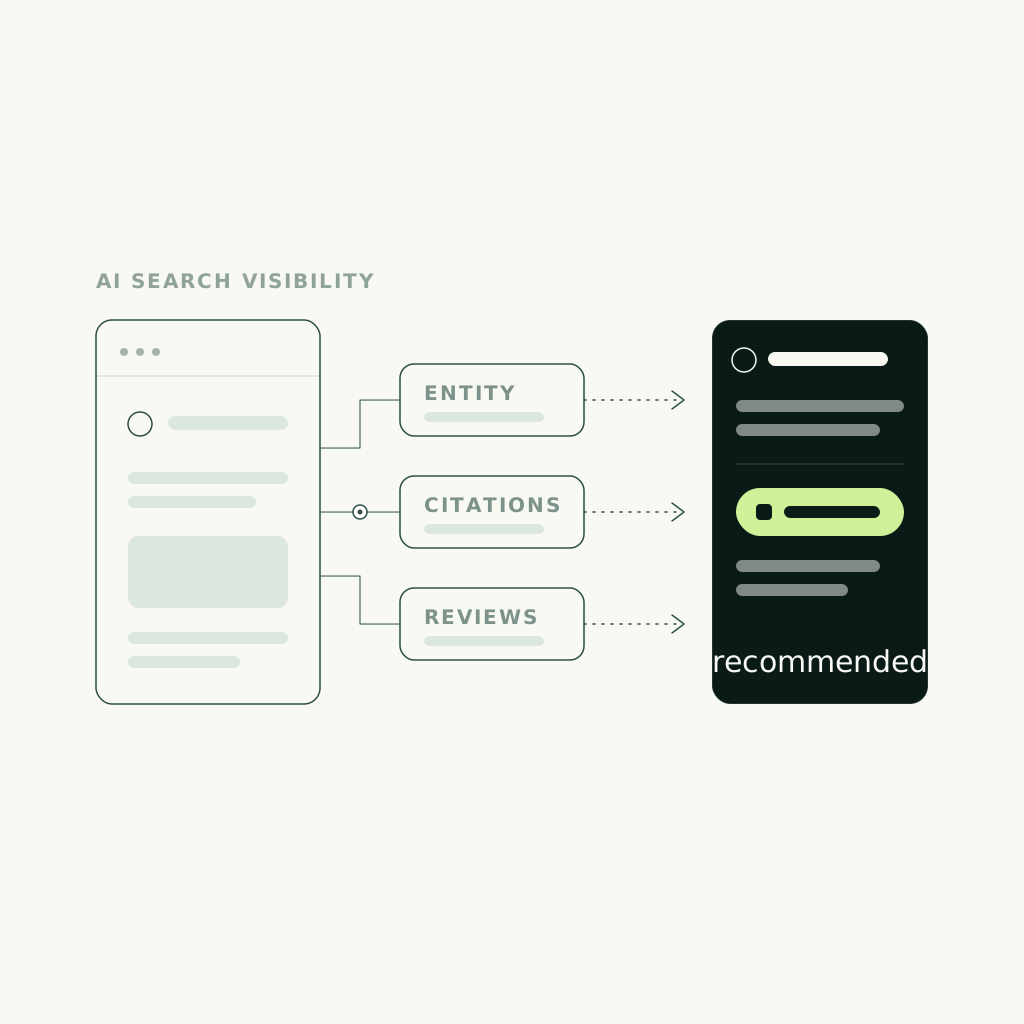
You get recommended by ChatGPT, Claude, and Perplexity by being the clearest, most consistent, most independently-verified answer to the questions your buyers ask them. Concretely: lead your important pages with the direct answer, describe your business identically everywhere it appears online, put real FAQs in visible HTML with schema, and earn mentions on sites you don't own — reviews, listicles, and recaps. Assistants extract and cite; they reward pages that are easy to quote and entities that look coherent across the web.
That's the whole playbook, and the rest of this guide is the practitioner's version of each move. Notice that this page follows its own advice — every section opens with the answer first, because that is exactly the structure an assistant can lift and cite.
THE SHIFT
Why buyers now ask who to hire.
Buyers ask assistants who to hire because it collapses a day of research into a paragraph. Instead of opening ten tabs and comparing them, a founder now asks ChatGPT 'who are the best medspa web designers in Vancouver?' or asks Claude to compare two studios, and starts from a shortlist the model already built. We're describing an observed shift, not a statistic — but you can watch it in your own behavior: the first draft of a vendor list increasingly comes from an assistant, and the human research happens after, to confirm names the model surfaced. That reorders the whole funnel. If you're not in the model's answer, you're not on the shortlist the buyer starts from — and you never get the chance to win the comparison.
THE MECHANICS
How assistants decide who to cite.
Assistants don't rank pages the way a search engine does; they assemble an answer from sources they can parse and trust. These are the levers that make you one of those sources — a practitioner's playbook, in the order we'd fix them.
Answer-first pages
Assistants extract answers, not atmosphere. A page that states the answer in its first two sentences — plainly, in the buyer's own words — is far easier to quote than one that buries the point under a brand story. Lead every important page with the direct answer, then support it with the detail. This single change does more for citability than any amount of keyword tuning.
Entity consistency
Models build a picture of who you are from how consistently you describe yourself across the web. The same company name, description, location, and service list on your site, LinkedIn, Clutch, and directory profiles tells an assistant you're a real, coherent entity worth naming. Contradictory or half-finished descriptions read as noise, and noise gets skipped.
Visible-HTML FAQs
FAQs answer the exact questions buyers type into assistants, in a format models parse cleanly — but only if the answer sits in the visible HTML, not injected by script or hidden behind an accordion a crawler can't open. Ask the real question a buyer would ask, and answer it in plain text on the page.
Structured data
FAQPage, Service, and Organization schema label your content so a model doesn't have to guess what it's looking at. Schema won't buy you a citation on its own, but it removes ambiguity about what your page is and who you are — and ambiguity is what gets a page passed over for a clearer one.
Third-party surface
Assistants trust what others say about you more than what you say about yourself. Reviews on Clutch and Google, inclusion in other people's 'best agencies' listicles, podcast recaps, and mentions on sites you don't own are the strongest citation signals of all. You earn this surface with real work and relationships; you can't schema your way to it.
THE SELF-TEST
The five-question test you can run today.
You don't need a tool to see where you stand — you need ten minutes, once a month. Open three assistants, ask the five questions your buyers would actually ask, and read who gets named and from which sources. Log the results so you can watch your standing move over time.
- Ask 'who are the best [your category] in [your city]?' — are you named at all?
- Ask 'who should I hire to [your core outcome]?' — do you appear, and how high?
- Ask the assistant to compare you to a named competitor — is the description of you accurate?
- Ask 'is [your company] any good?' — what does it say, and which sources is it pulling from?
- Repeat all four across ChatGPT, Claude, and Perplexity — the answers differ by model, and so should your read.
THE METRIC
What 'share of answer' actually means.
Share of answer is your market share of the AI layer: across the buyer questions that matter in your category, how often are you the one the assistant names? A traditional rank tracker asks 'where do I sit on the results page?' Share of answer asks the sharper question — 'when a buyer asks an assistant who to hire, how often is it me, and is what it says about me right?' You measure it by running a fixed panel of buyer questions across the major assistants on a schedule, then tracking how often and how accurately you're cited. The manual self-test above is how you start; a repeatable panel is how you turn it into a number you can move.
THE FIX
What it takes to become the answer.
Fixing your AI visibility is mostly unglamorous groundwork, run in order: rewrite key pages answer-first, make your entity description identical everywhere it appears, put real FAQs in visible HTML with schema, and earn third-party mentions you don't control. One concrete, often-skipped piece is an llms.txt file — a plain-text map that tells assistants which of your pages matter. We publish our own llms.txt as a worked example: it auto-lists every guide and page we want models to find, so an assistant crawling Side Studios gets a clean index instead of guessing. If your site was generated fast by an AI builder and reads generically, the groundwork is bigger, and that's the territory of our guide at fix ai generated website. When you want this run as an ongoing program — share-of-answer tracking, entity and schema work, and citation building — that's our AI-Search Visibility track, from $1,500/mo, detailed on the pricing page. And a Brand Score is the fastest way to see where your site stands today, including how ready it is to be cited.
FAQ
Common questions.
How do I get my business recommended by ChatGPT?
Be the clearest, most consistent, most independently-verified answer to the questions your buyers ask it. In practice that means answer-first pages, an identical entity description across your site, LinkedIn, and directories, real FAQs in visible HTML with schema, and third-party mentions like reviews and listicles. Assistants assemble answers from sources they can parse and trust, so you win by being easy to quote and coherent across the web.
Why doesn't ChatGPT mention my company?
Usually because it can't find a clear, consistent, independently-corroborated picture of you. If your pages bury the answer, your description differs across profiles, your FAQs are hidden behind script, or nobody outside your own site vouches for you, an assistant has nothing clean to cite and names a clearer competitor instead. Run the five-question self-test in this guide to see exactly where the gap is.
What is generative engine optimization (GEO)?
GEO is the practice of getting cited and recommended inside AI assistants like ChatGPT, Claude, and Perplexity, the way SEO is the practice of ranking in search engines. It focuses on answer-first content, entity consistency, structured data, and third-party citation surface — the signals models use to decide whose answer to lift. It complements SEO rather than replacing it.
Does schema markup help with AI search?
Yes, indirectly. Schema like FAQPage, Service, and Organization labels your content so a model doesn't have to guess what a page is or who you are, which removes the ambiguity that gets pages skipped. It won't earn a citation on its own — answer-first writing and third-party trust do the heavy lifting — but it makes everything else easier for an assistant to use.
What is an llms.txt file?
An llms.txt file is a plain-text file at the root of your site that maps the pages you most want AI assistants to find and understand, so a crawler gets a clean index instead of guessing. We publish our own llms.txt as a worked example — it auto-lists every guide and key page. It's a small, concrete step toward being cited, not a magic switch, but it's one of the easiest to ship.
How is GEO different from SEO?
SEO optimizes for a ranked list of blue links; GEO optimizes for being named inside a single assembled answer. SEO rewards pages; GEO rewards clear answers and coherent entities that models trust enough to cite. The groundwork overlaps — good content, clean structure, real authority — but the metric changes from 'where do I rank?' to 'how often is my answer the one the assistant gives?'